
RFID vs ANPR: What Is the Difference?
Quick answer: RFID identifies a credential; ANPR reads the vehicle plate
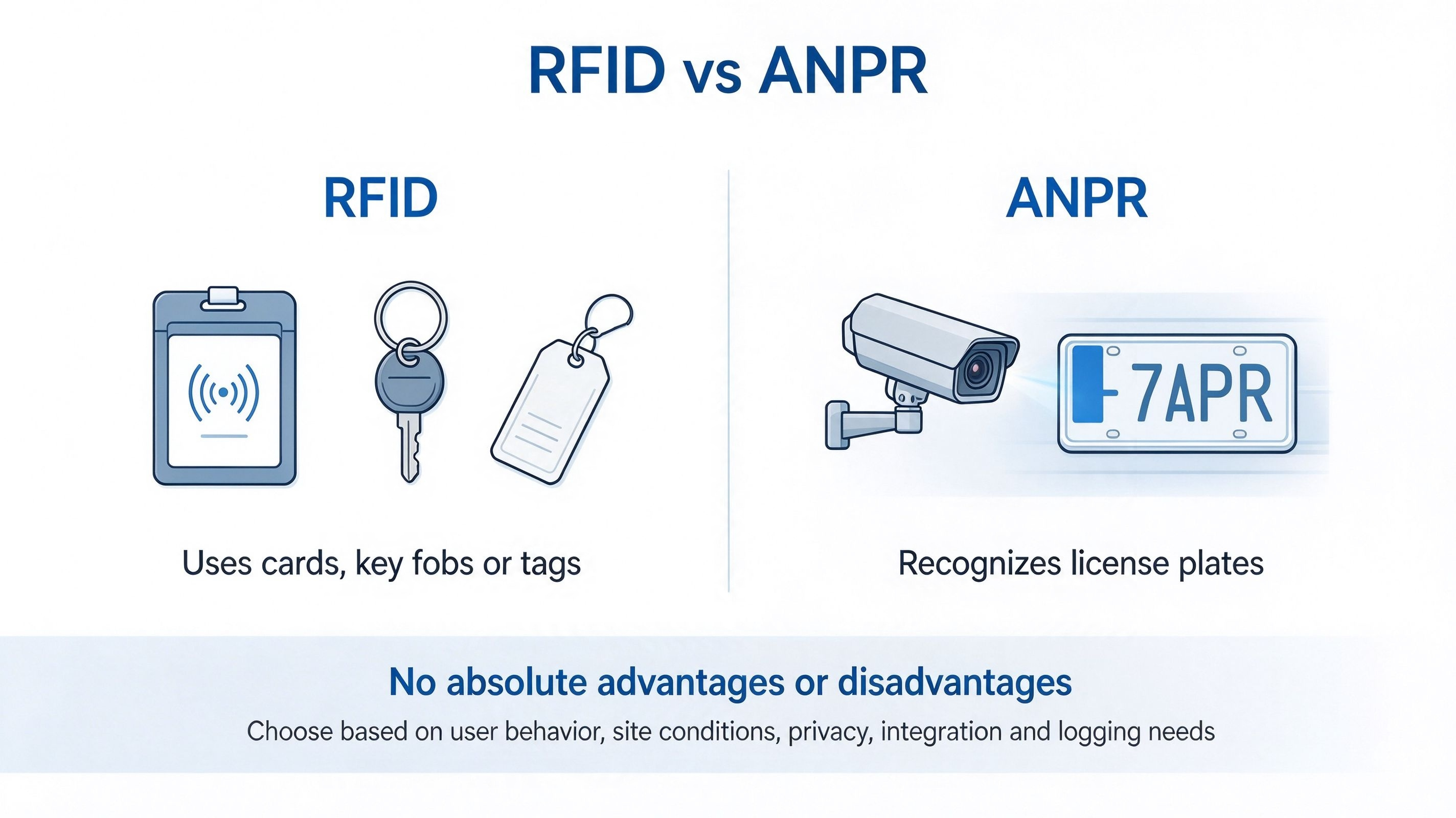
RFID and ANPR are different technologies that can be used to authorize vehicle entry and exit in a parking facility. In an RFID system, a reader detects a compatible tag or credential, usually installed in the vehicle or presented by the user. In an ANPR system, a camera captures an image of the plate and software attempts to recognize the characters to verify authorization. The choice depends on vehicle flow, user profile, site conditions, budget and security rules.
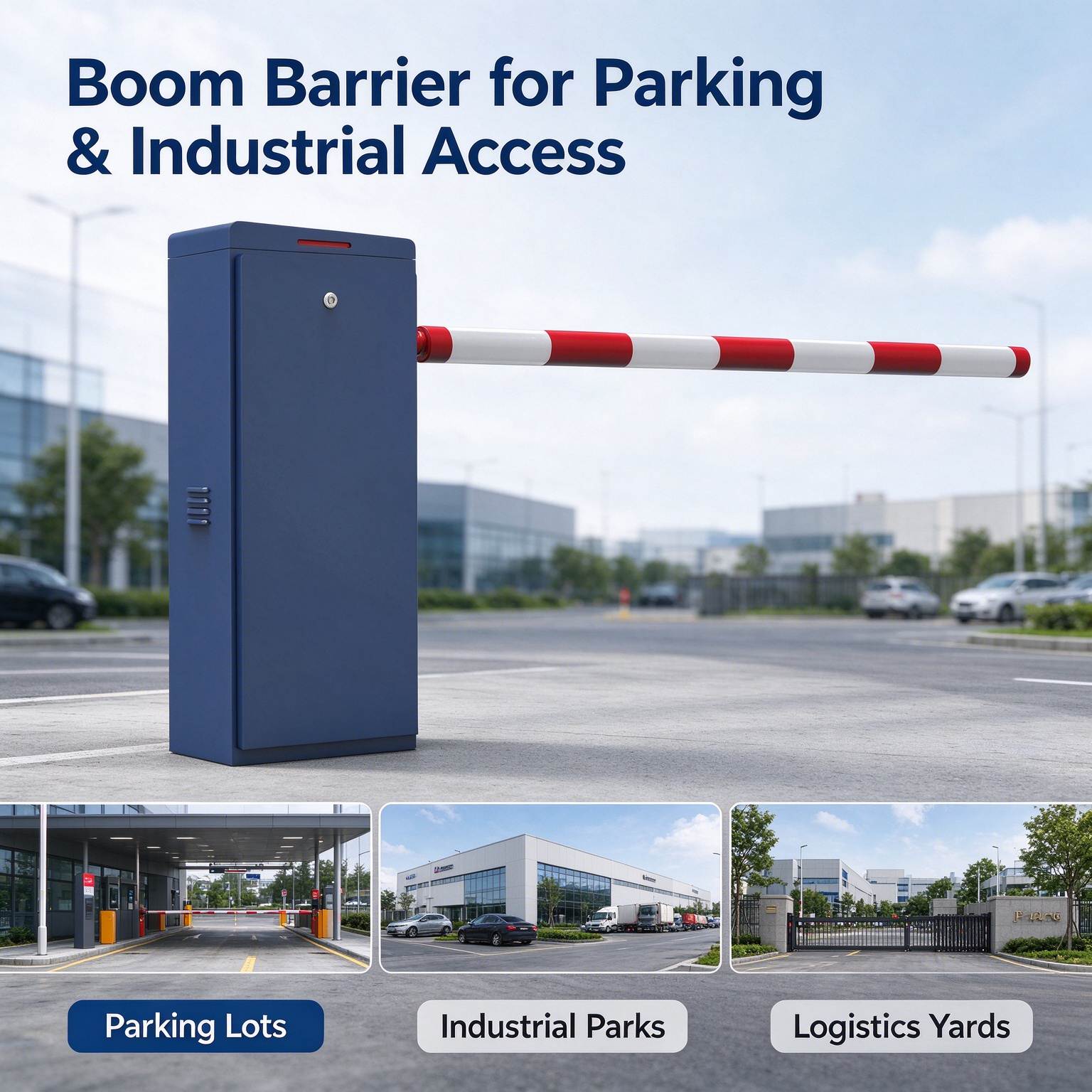
These technologies are not, in themselves, the barrier gate. They are part of the access control system and must communicate with a controller and a compatible automatic barrier gate. Before purchasing, confirm the available interfaces, the additional equipment required and the compatibility between components.
1. How does RFID access control work?
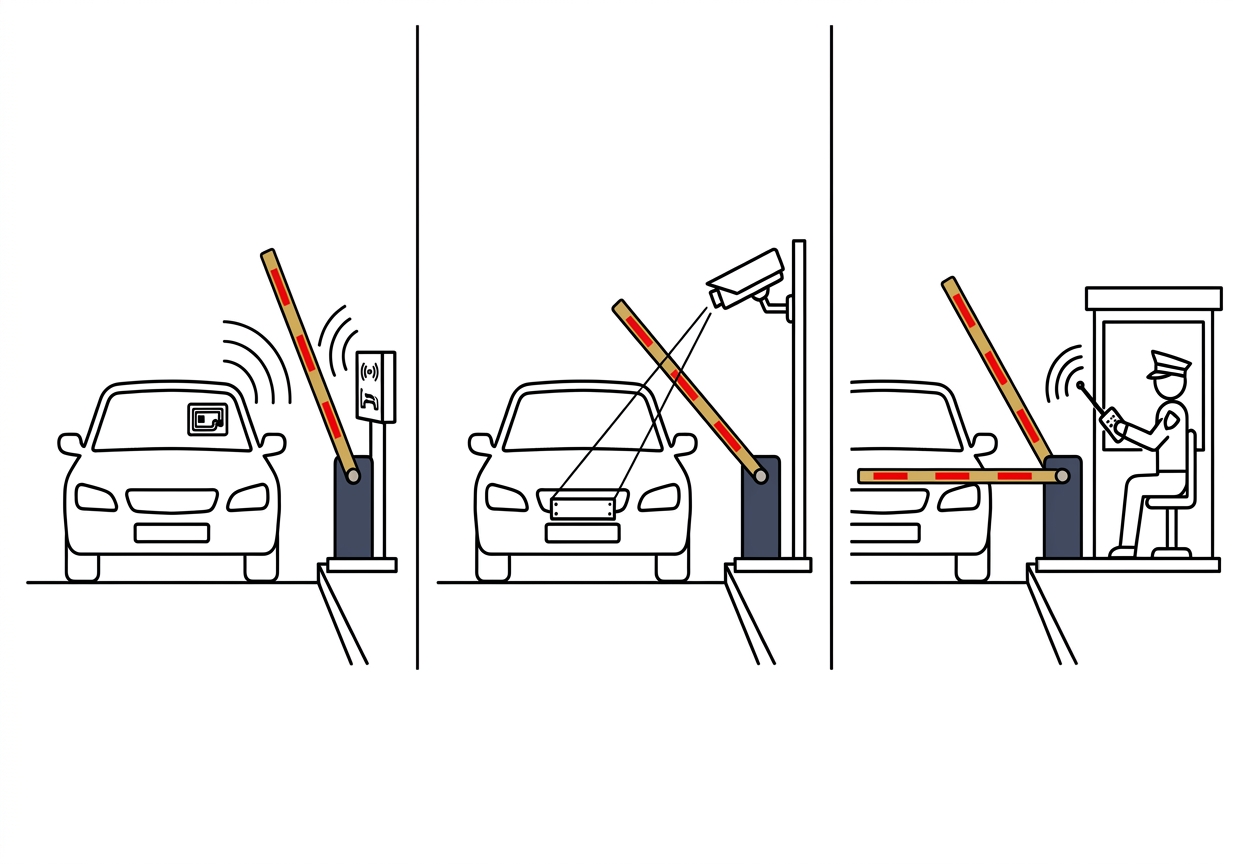
RFID stands for radio frequency identification. In vehicle access, an RFID tag or credential transmits or responds to a signal that can be read by compatible equipment. When the credential is recognized and authorized in the system, the controller can send the opening command to the barrier gate, according to the configured logic.
The tag may be installed in the vehicle or presented by the user, depending on the system type. Read range, installation position, credential type and the frequency used depend on the equipment chosen. For this reason, do not assume that any card or tag will work with any RFID reader.
RFID is often convenient when users are recurring and can receive pre-registered credentials, such as residents, employees or subscribers. The system also allows permissions to be revoked or changed in the registration, provided the platform used offers this function.
2. How does ANPR or LPR work?
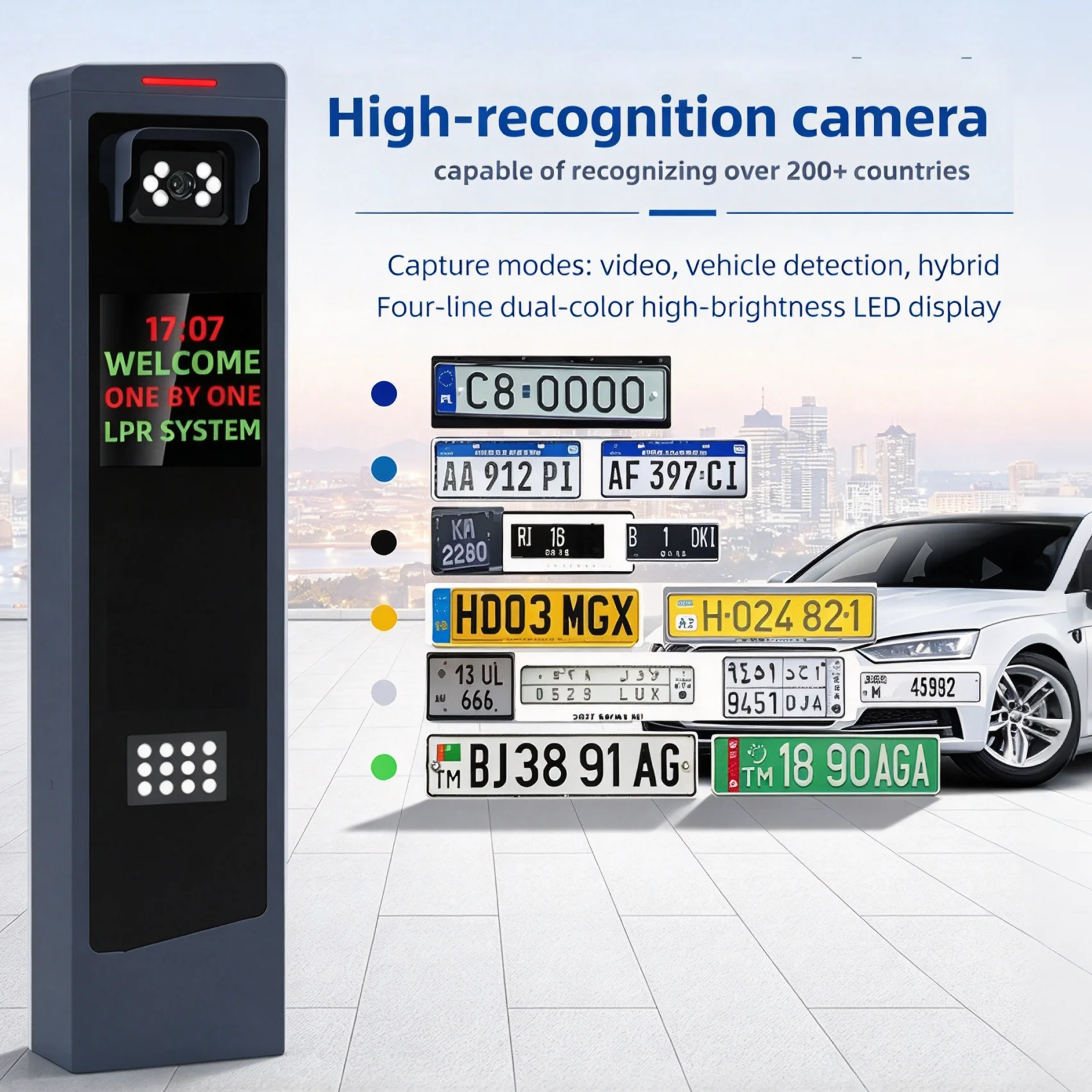
ANPR stands for automatic number plate recognition; LPR is another common acronym for license plate recognition. In this system, a camera captures the vehicle plate and the software processes the image to identify the characters. The platform compares the result with the access rules or an authorized list and, if the criteria are met, can request the barrier gate to open.
The result depends on image quality, camera angle, lighting, vehicle speed, plate cleanliness and software configuration. Dirty, damaged or partially obscured plates, or plates captured under unfavorable conditions, can reduce the recognition rate. The solution must be tested at the actual access point, not only under ideal demonstration conditions.
ANPR can reduce the need for physical cards or tags for registered users. However, it is necessary to define what happens when the plate is not recognized, when the vehicle is not registered, or when the camera, the network or the software is unavailable.
3. RFID vs. ANPR: key differences
| Criterion | RFID | ANPR/LPR | | --- | --- | --- | | What it identifies | A compatible tag or credential | The characters on the vehicle plate | | Main element | RFID reader and credential | Camera and recognition software | | User action | May require a registered tag or card | Generally, the plate must be visible to the camera | | Registration | Credentials and permissions | Plates and authorization rules | | Performance dependencies | Compatibility, position and read range | Image, lighting, angle, plate and software | | Situations requiring contingency | Lost, damaged or unread credential | Illegible or unregistered plate, or camera unavailable | | Additional equipment | Compatible reader and credentials | Compatible camera, software and infrastructure | | Privacy | Credential records and access events | Images, plates and access records, depending on configuration |
The table presents general differences. Actual features, integration, performance and costs vary according to the manufacturer, the model, the software and the installation conditions.
4. Which technology is more suitable for a condominium?
In condominiums with recurring residents and employees, RFID can be a practical option when the administration can distribute and manage credentials. It is important to define the process for registering new users, blocking lost credentials and controlling access for visitors and service providers.
ANPR can be attractive when the administration prefers to link authorization to the registered plate and reduce the use of physical credentials. Before choosing, check whether the camera can capture plates under the entrance's real conditions and whether there is a procedure for visitor vehicles, temporary plates or vehicles whose registered plate changes.
There is no single answer for every condominium. Traffic volume, the number of users, budget, staff availability and internal rules should guide the decision.
5. Which works better in commercial parking facilities?
In commercial parking facilities, the decision should consider the billing method, the length of stay, the number of recurring users, the visitor flow and the integration with the management system. RFID can work well for employees, monthly subscribers or registered fleets. ANPR can be useful when the operation depends on plate identification or needs to link entry and exit to the vehicle record.
Before defining the architecture, map the complete flow: vehicle arrival, identification, authorization, barrier opening, passage, entry or exit record and exception handling. A fast read does not guarantee a short queue if payment, validation or the connection to the central system causes delays.
6. Can RFID and ANPR be combined?
Yes. Depending on the platform and the integration available, RFID and ANPR can be used together. For example, a system may use RFID for recurring users and license plate recognition as an additional verification step, or offer different methods for different user groups. Feasibility depends on the controller, the software, the interfaces and the access rules.
A combined approach can offer flexibility, but it can also increase the investment, the configuration complexity and the support requirements. Before opting for it, define which problem the integration solves and ask the supplier to describe the components, the licenses and the additional costs.
7. Security, failures and fallback operation
No identification system should be considered infallible. Define how the operator will act if the RFID tag is not read, if a plate is not recognized, if the network goes down or if there is a power failure. The fallback procedure must preserve security and prevent the barrier gate from being opened without authorization.
Assess the sensors and safety devices required for the barrier gate, including vehicle detection in the movement zone and pedestrian protection, in line with the risk assessment and the manufacturer's instructions. The identification system does not replace physical safety devices.
Also define who can change credential or plate lists, how permissions are reviewed and how access records are protected. Administrative access should be limited to authorized personnel.
8. Privacy and the LGPD in Brazil
Credential, plate, time and image records may involve personal data, depending on how they are linked to an identifiable person and how the system is operated. Before deploying RFID or ANPR, assess the purpose of processing, the applicable legal basis, who can access the data, how long it will be retained and how it will be protected, in accordance with the LGPD (Brazil's data protection law) and relevant legal guidance.
Do not collect or retain more information than necessary for the defined purpose. Document the responsibilities among the parking facility owner, the administrator, the integrator and the software suppliers.
9. How to compare total cost?
Do not compare only the price of the RFID reader with the price of the ANPR camera. Include controllers, credentials, cameras, software, licenses, network, cabling, installation, integration with the barrier gate, maintenance and training. Costs can vary considerably depending on the number of lanes, the features required and the existing infrastructure.
Request proposals with the same functional scope and ask for mandatory and optional items to be separated. Also confirm the availability of technical support, updates, parts and recovery procedures in the event of failure.
10. How to evaluate a BAROXON solution
When evaluating a BAROXON solution for access control, consult the official catalog and confirm which barrier gate models, interfaces and integration options are actually available for the project. Do not assume that an RFID reader, an ANPR camera, software or a specific function is included with the basic barrier gate.
Ask the supplier for written confirmation of compatibility between the barrier gate, the controller, the reader or camera, the software and the safety sensors. Request a list of the required components, the installation requirements and the recommended acceptance tests for the site.
Frequently asked questions
Is RFID better than ANPR for parking?
It depends on the use. RFID can be convenient for recurring users with registered credentials; ANPR can be useful when the operation needs to identify vehicles by plate. The choice should consider the site, the traffic flow, the infrastructure and the total cost.
Does ANPR work at night?
It can work if the camera, the lighting and the software are suited to the real conditions. Confirm the equipment specifications and test reading at night, under headlights, shadows and other factors present at the entrance.
Does RFID require a tag in every vehicle?
In many vehicle systems, yes, but this depends on the chosen architecture. Confirm the credential type, the installation method and the compatibility with the reader before purchasing.
Can I use RFID and ANPR on the same barrier gate?
It may be possible when the controller, the software and the interfaces allow integration. Request technical validation for the specific configuration and confirm the additional costs.
What should I ask the supplier?
Ask which components are included, which technologies are compatible, how data is handled, what the contingency procedure is, what the installation requirements are and what support is available after deployment.
Conclusion
RFID and ANPR solve similar needs through different means: RFID reads a compatible credential, while ANPR attempts to recognize the vehicle plate from an image. To choose, assess the user profile, the traffic flow, the reading quality at the site, the integration with the barrier gate, privacy, security and total cost. The best solution is the one that meets the parking facility's real conditions and whose compatibility has been confirmed technically.